

From Emotional Patterns to Personal Freedom: Understanding Yourself and Creating Real Change
Sometimes we know exactly what we want to change, yet we find ourselves repeating the same emotional reactions, behaviours and relationship patterns.
We promise ourselves that this time will be different.
But then something happens.
Someone says something that triggers us.
We feel rejected, criticised, ignored or misunderstood.
We become anxious.
We withdraw.
We become angry.
We try to please.
We overthink.
We seek reassurance.
We say yes when we really want to say no.
And afterwards, we may wonder:
“Why did I react like that?”
This is where understanding our emotional patterns can become an important step towards personal freedom.
Because change isn't always about trying harder.
Sometimes, it's about understanding what is happening underneath the behaviour.
What are emotional patterns?
An emotional pattern is a familiar way of thinking, feeling and responding that develops over time.
It can become almost automatic.
A situation happens → an emotion is triggered → a familiar thought appears → we respond in a familiar way.
And because we've experienced the pattern many times, it can feel like “this is just who I am.”
But a pattern is not necessarily your identity.
It is something you have learned.
And what has been learned can potentially be understood, questioned and changed.
For example, imagine someone doesn't respond to your message.
The event itself is simple:
They haven't replied.
But your emotional response might be:
“They're upset with me.”
Then:
“I must have done something wrong.”
Then:
“Maybe they don't care about me.”
You become anxious.
You send another message.
You check your phone repeatedly.
You seek reassurance.
And eventually you might feel embarrassed about your reaction.
The emotional intensity may have little to do with the unanswered message itself.
It may be connected to something deeper.
Perhaps the situation has activated an old fear of rejection, abandonment, not being good enough or not being valued.
This is why emotional patterns deserve our attention.
Your emotions are part of the story
One of the most important things we can learn about emotional health is that emotions are not problems that need to be eliminated.
Emotions carry information.
They can tell us something about how we are experiencing a situation, what we perceive as threatening, what we value, what we need and where something may feel out of alignment.
But there is an important distinction:
An emotion is real, but the interpretation attached to it isn't necessarily a complete picture of reality.
You can feel rejected without necessarily being rejected.
You can feel unsafe without necessarily being in danger.
You can feel guilty without necessarily having done something wrong.
You can feel unworthy without actually being unworthy.
This distinction can create an important space between what you feel and what you choose to believe or do because of that feeling.
And that space is where greater choice becomes possible.
Why do we repeat patterns we don't want?
One of the frustrating things about emotional patterns is that they often continue even when we consciously want to change.
You may know you need stronger boundaries.
Yet you keep saying yes.
You may know that constantly seeking approval is exhausting.
Yet you continue looking for reassurance.
You may know that overthinking doesn't solve the problem.
Yet your mind keeps going around in circles.
You may know that a particular relationship dynamic isn't healthy for you.
Yet you find yourself drawn back into it.
Why?
Because human behaviour isn't driven only by conscious decisions.
Our responses can also be influenced by previous experiences, learned beliefs, emotional associations and deeply established habits.
Something in the present can activate something from the past.
And when that happens, we may respond from an old emotional template rather than from the person we are today.
The difference between a trigger and a choice
Imagine someone makes a comment that reminds you of being criticised in the past.
You immediately feel angry.
Your body becomes tense.
Your thoughts become defensive.
You want to attack, withdraw or prove yourself.
The reaction may happen before you've had time to consciously think about it.
That's the trigger.
But the trigger doesn't have to determine what happens next.
With greater emotional awareness, you can learn to notice:
“Something has been activated in me.”
Instead of immediately reacting, you can pause.
Breathe.
Notice the emotion.
Identify the thought.
Ask yourself:
“What is happening right now?”
“What am I feeling?”
“What am I telling myself?”
“Is this response about what is happening now, or is something from my past being activated?”
That pause can be incredibly powerful.
Because emotional freedom isn't about never being triggered.
It's about developing more choice in what you do when you are triggered.
The hidden cost of living on autopilot
When emotional patterns remain unconscious, they can influence many areas of our lives.
They can affect:
Relationships
Boundaries
Communication
Confidence
Decision-making
Self-esteem
Work
Family dynamics
How we respond to conflict
How we treat ourselves
And sometimes the most difficult part is that the pattern can become so familiar that we don't even recognise it as a pattern.
We simply think:
“That's just the way I am.”
But consider the difference between saying:
“I'm a people pleaser.”
and asking:
“What happens emotionally inside me when I consider disappointing someone?”
The first statement describes an identity.
The second creates an opportunity for exploration.
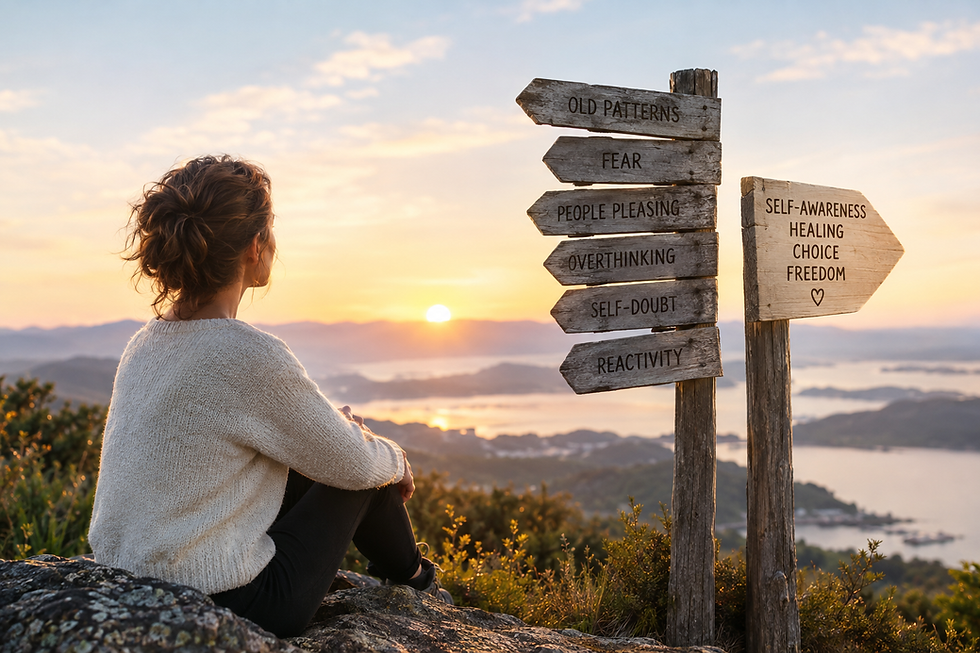
Perhaps underneath the people-pleasing is fear.
Fear of rejection.
Fear of conflict.
Fear of being judged.
Fear of losing connection.
Fear of not being enough.
Once we understand what is underneath the behaviour, we have much more useful information to work with.
Awareness comes before change
We often want to jump straight to changing the behaviour.
“I need to stop overthinking.”
“I need to stop people pleasing.”
“I need to be more confident.”
“I need better boundaries.”
But sustainable change often begins earlier.
It begins with awareness.
What is the pattern?
When does it happen?
What triggers it?
What emotion appears?
What thought follows?
What do I do next?
What does that behaviour give me in the short term?
And what does it cost me in the long term?
These questions can reveal something important.
Many behaviours that create problems in the long term may have developed because they once served a purpose.
People-pleasing might have helped you maintain connection.
Avoidance might have helped you escape conflict.
Overthinking might have given you a sense of control when things felt uncertain.
Seeking validation might temporarily reduced insecurity.
The behaviour may no longer be serving you, but understanding why it developed can create compassion rather than shame.
You are not your emotional pattern
This is one of the most important distinctions in emotional growth.
You may have learned to avoid conflict.
But you are not an avoidant person forever.
You may have learned to seek approval.
But you are not permanently a people pleaser.
You may have developed a habit of overthinking.
But that doesn't mean you are incapable of trusting yourself.
Patterns can be persistent.
But persistence doesn't make them permanent.
When we stop defining ourselves by our patterns, we create room for something new.
Personal freedom doesn't mean controlling everything
We sometimes imagine freedom as having a life where nothing difficult happens.
No conflict.
No rejection.
No uncertainty.
No disappointment.
No difficult emotions.
But that's not realistic.
Life will continue to bring experiences we cannot control.
People will sometimes misunderstand us.
Plans will change.
Relationships will evolve.
We will make mistakes.
We will experience loss.
We will feel fear, sadness, anger and uncertainty.
Personal freedom isn't about controlling all of this.
It is about developing greater freedom in how we relate to what happens.
You may not be able to control what someone says.
But you can become more aware of how you respond.
You may not be able to control whether someone approves of you.
But you can work on how much their approval determines your sense of worth.
You may not be able to change the past.
But you can explore how the past continues to influence the present.
And you can begin making choices from who you are today rather than automatically responding from old emotional patterns.
From reaction to response
There is a subtle but important difference between reacting and responding.
A reaction is often automatic.
A response contains awareness and choice.
Someone criticises you.
Reaction:
“You always do this. I'm sick of you.”
Response:
“I'm feeling defensive right now. I need a moment before I respond.”
Someone asks you to do something you don't want to do.
Reaction:
“Sure, no problem.”
And then you spend the next three days feeling resentful.
Response:
“Let me think about it and get back to you.”
Someone disagrees with you.
Reaction:
“They don't respect me.”
Response:
“I notice that disagreement is bringing up something uncomfortable for me. Let me understand what I'm feeling before I decide how I want to respond.”
The difference may seem small.
But repeated small moments of choice can create profound changes over time.
What emotional freedom can look like
Emotional freedom doesn't necessarily look dramatic.
Sometimes it looks like saying no without spending the entire night feeling guilty.
Sometimes it looks like allowing someone to be disappointed without immediately rushing to fix their feelings.
Sometimes it looks like expressing what you need instead of hoping someone will guess.
Sometimes it means leaving an argument instead of trying to prove that you're right.
Sometimes it means recognising that you are upset and giving yourself permission to feel it.
Sometimes it means forgiving yourself for something you did when you didn't know what you know today.
Sometimes it means choosing yourself without needing everyone else to understand your choice.
These moments may look ordinary from the outside.
But internally, they can represent something significant:
You are no longer automatically repeating the old pattern.
A simple exercise: Notice your pattern
The next time you experience a strong emotional reaction, don't immediately try to change it.
Instead, become curious.
Write down:
1. What happened?
Describe the situation as objectively as possible.
2. What did I feel?
Name the emotion.
3. What did I think?
What story did your mind immediately create?
4. What did I want to do?
Did you want to withdraw, attack, please, fix, avoid, explain, control or seek reassurance?
5. What might this reaction be connected to?
Does it remind you of another experience, relationship or period of your life?
6. What would I choose if I didn't have to automatically follow the pattern?
You don't have to have all the answers.
The purpose is to begin seeing the pattern.
Because you can't change something you haven't yet learned to recognise.
The journey from emotional patterns to personal freedom
This is the heart of the work I explore through my emotional health coaching and workshops.
My approach is not about telling you how you should feel.
It's about helping you develop a deeper understanding of your emotional world.
We explore the connection between:
Emotions → Thoughts → Patterns → Behaviours → Choices
When you become more aware of that connection, you can begin to question patterns that may have been operating automatically for years.
You can develop tools for emotional regulation.
You can become more aware of your triggers.
You can explore the beliefs behind recurring behaviours.
You can develop healthier ways of responding.
And, perhaps most importantly, you can begin to relate to yourself with greater understanding rather than judgment.
This isn't about becoming a completely different person.
It's about becoming more conscious of the person you already are — and creating the freedom to choose what comes next.
From Emotional Patterns to Personal Freedom
This is the theme of my upcoming workshop at Pure Body Yoga & Wellness Centre in Pambula, NSW.
From Emotional Patterns to Personal Freedom
Pure Body Yoga & Wellness Centre, Pambula NSW
24 October 2026
10:00am – 12:30pm
During the workshop, we'll go deeper into the emotional patterns that can influence the way we think, feel, behave and relate to ourselves and others.
We'll explore practical ways to increase emotional awareness, understand what may be underneath recurring reactions, and create more space between an emotional trigger and your response.
The intention isn't to tell you who you should be.
It's to give you the opportunity to understand yourself more deeply and discover where you may have more choice than you realised.
If this article made you pause and recognise yourself...
Don't just keep reading and move on.
Take a moment to think about one pattern you would genuinely like to understand better.
Maybe it's:
People pleasing.
Overthinking.
Difficulty setting boundaries.
Seeking validation.
Fear of rejection.
Suppressing emotions.
Repeating relationship patterns.
Being constantly hard on yourself.
You don't have to change everything at once.
Start by noticing.
Because awareness creates the possibility of choice.
And choice is where personal freedom begins.
Join us in Pambula
If you'd like to explore this work more deeply, I'd love you to join me for the workshop.
From Emotional Patterns to Personal Freedom
24 October 202610:00am – 12:30pm
Pure Body Yoga & Wellness Centre, Pambula NSW
Read, reflect, and take the next step: https://www.emotionalhealthcoach.com.au/workshop-registration
Your emotional patterns may have been shaped by your past.
But they don't have to define your future.
“The past is an experience not a residence”
You may not be able to change everything that happened to you.
But you can begin changing the way you relate to what happened, and the choices you make today.
That is where the journey from emotional patterns to personal freedom begins.



Comments